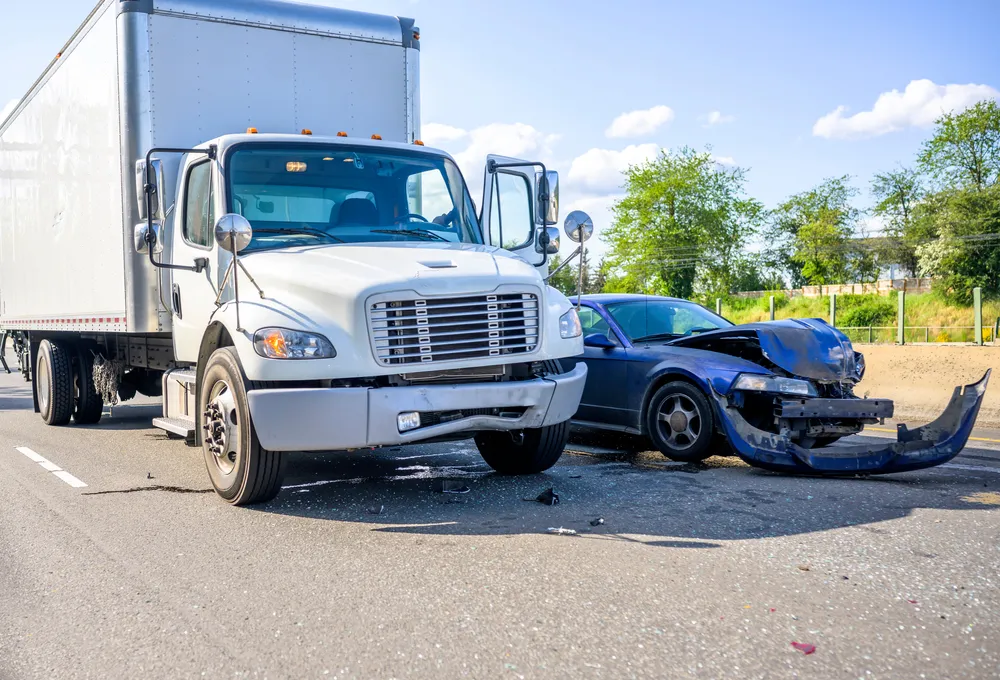
How Black Box (EDR) Data Proves Fault in Commercial Truck Accidents
table of contents
In 2023, truck crashes killed 5,472 people across the United States. Seventy percent were riding in passenger vehicles. After a collision like that, the injured person faces what feels impossible: proving the driver of an 80,000-pound truck was at fault. The driver denies everything. The trucking company backs him up. But inside the cab sits a device that doesn't deny anything.
It's called the “black box.” The technical names are EDR (event data recorder) and ECM (electronic control module). Black box data in truck accident cases regularly becomes the strongest evidence of negligence. Here's how it works, what it records, why carriers try to make that data disappear, and how an attorney uses it to prove fault.
What Is a Commercial Truck Black Box (EDR)?
Every modern commercial truck runs on an ECM: the central computer that controls the engine, brakes, and transmission. Built into it is a module that logs driving data. Speed, engine RPMs, brake application and pressure, ABS status, steering inputs and cruise control activity. Depending on the model, the system tracks over 100 parameters.
Passenger car EDRs capture a brief snapshot (5 to 30 seconds before impact). Commercial trucks go further. The ECM stores long-running engine history. ELD (electronic logging device) data tracks driving hours. GPS and telematics systems log the route. Together they build a digital timeline: where the truck was, how long the driver had been driving, and whether brakes were applied before the collision.
How EDR Data Exposes Negligent Truck Drivers
Proving Speeding and Reckless Driving
The ECM logs speed down to the second. If the truck was doing 75 in a 55 zone, that's a timestamped number, not speculation. Acceleration data, throttle position, and cruise control status are all recorded. An accident reconstruction expert cross-references this with road conditions and weather. The result is an objective picture of how the driver operated the truck in the minutes before impact.
Exposing Late Braking or Failure to Brake
FMCSA data shows that roughly 29% of trucks in serious collisions had brake system issues. The ECM records the exact moment the driver pressed the pedal, system pressure, and whether ABS engaged. If the driver braked half a second before impact when they should have started four seconds earlier, the data shows it. Brakes that failed because of negligent supervision or maintenance show up just as clearly.
Linking ELD Data to Fatigue Violations
Federal hours-of-service limits (49 CFR § 395.3) cap driving at 11 hours within a 14-hour window, with mandatory 10-hour rest before each shift and a 30-minute break after 8 hours. Since 2017, every carrier must track time with an ELD (49 CFR § 395.22).
When a driver logs 16 hours instead of 11, that fatigue violation is recorded. FMCSA research found 13% of truck drivers involved in crashes were fatigued. Eighteen hours without sleep impairs reaction time the same as a 0.08% blood alcohol level. ELD data turns vague claims about “tiredness” into documented federal violations with exact numbers.
Why Trucking Companies Try to Hide or Destroy Black Box Data
ECM records can be overwritten when the engine restarts. ELD logs must be kept for six months, and tampering is prohibited (49 CFR § 395.8(e)), but the law doesn't guarantee records last forever. Maintenance records only need one year of retention.
The carrier's insurer typically sends a “rapid response team” to the scene within hours. They download ECM data, photograph the scene, interview witnesses. While the injured person is still in the hospital, the defense already controls the evidence.
This is why a truck wreck lawyer sends a spoliation letter within 24 hours. It names every system: EDR/ECM data, 90 days of ELD records, GPS logs, dispatch communications, the driver's qualification file, maintenance records, drug and alcohol test results. If the company destroys data after receiving that letter, the court can apply an adverse inference: a presumption that the destroyed evidence would have hurt the defendant.
How Your Truck Accident Lawyer Uses EDR Data to Win Your Case
So how does the black box help a truck accident case in practice? Getting the data is the first step. You then need an accident reconstruction expert to extract information from the ECM, cross-reference it with the police report and medical records, and build a narrative the jury can follow. Black box data in truck accident litigation often becomes the piece that tips a case from “he said, she said” into clear liability.
Kermani LLP starts with an immediate spoliation letter. Our team works with EDR specialists to lock down evidence before it gets overwritten or “lost.” We handle these cases on a contingency fee basis: you pay nothing unless we win. Call for a free consultation.
Frequently Asked Questions (FAQs)
Who Owns the Black Box Data After a Semi-Truck Crash?
The device belongs to the trucking company or its leasing partner, but that doesn't give them free reign over the data. A crash with injuries triggers a duty to preserve evidence. Your attorney obtains records through discovery or subpoena. Destroying them means court sanctions.
How Long Does a Black Box Keep Data Before It Is Erased?
Depends on the manufacturer. Cummins, Detroit Diesel, and Volvo all use different ECM systems with different retention windows. Some overwrite after a certain number of ignition cycles. ELD records must be kept for six months by law. GPS data gets purged per company policy. The clock is ticking, and the faster your attorney sends a spoliation letter, the more data survives.
Can I Access the Truck's EDR Data Without a Lawyer?
Nothing legally stops you from asking. But trucking companies don't voluntarily hand data to private individuals. Pulling information from an ECM takes certified technicians with specialized equipment. Interpreting it takes a reconstruction expert. And keeping the company from “accidentally” overwriting records during routine maintenance takes a spoliation letter. Without legal pressure, your chances of getting complete, untouched black box data from a truck accident are close to zero.


Discover your legal options. Get a free case review, and pay nothing unless we win.



Receive a FREE case assessment
Every case is unique, so we tailor our approach to meet your specific needs.