Arizona's motorcycle lane filtering law: Who is at fault in an accident?
table of contents
Police reports after these crashes usually carry one line: the motorcycle was traveling between lanes. An adjuster reads that as an admission of fault and before 2022 they would have had a point. The law changed. The habit of reading it that way did not.
The difference between two similar maneuvers now costs money. One has been legal since September 24, 2022. The other is banned and this September it starts counting as a criminal offense. This is where that line runs and how fault gets divided after a crash.
What is lane filtering and how is it different from lane splitting
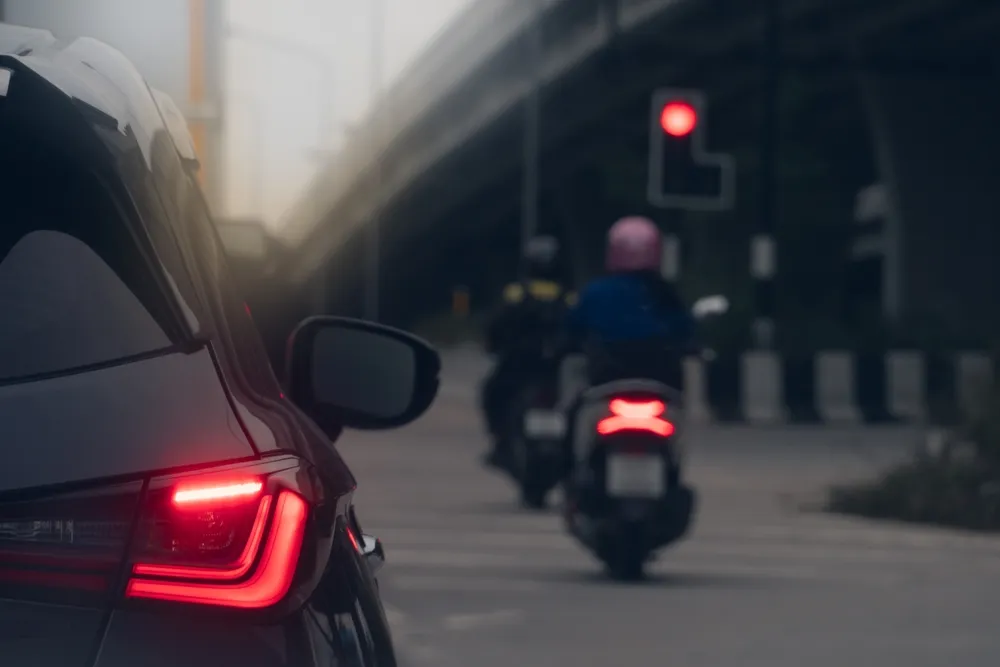
Lane filtering means moving slowly between rows of stopped cars: at a red light, at the back of a jam, in the queue for a freeway exit. Lane splitting means riding between rows of moving traffic, usually faster than the traffic itself. So is lane filtering legal in Arizona? That question and the same one about lane splitting have different answers.
Arizona legalized only the first and the lane splitting vs lane filtering line runs through the statute itself. A.R.S. § 28-903(B) bars passing within the lane the overtaken vehicle occupies and § 28-903(C) bars riding between lanes or between adjacent rows of vehicles.
Arizona laws on lane splitting and lane filtering differ in more than definitions. Starting September 12, 2026, violating subsection B or C counts as reckless driving: a class 2 misdemeanor, not an ordinary traffic ticket (HB 2941, Chapter 261, Laws of 2026).
Arizona’s lane filtering law (SB 1273)
SB 1273 created the rule. Governor Doug Ducey signed it on March 23, 2022 as Chapter 42, Laws of 2022 and it took effect on September 24. The bill added subsection F to A.R.S. § 28-903, permitting what had been banned outright.
But the Arizona lane filtering law protects a rider only when every condition holds at once:
- The road is divided into at least two lanes running the same direction and the posted limit is 45 mph or less.
- The vehicle you pass is actually stopped rather than creeping forward and your motorcycle has two wheels.
- Your own speed stays at or under 15 mph.
- The movement can be made safely.
That last condition is a judgment call and the fight in a case almost always lands there. The statute itself says nothing about fault in a crash. It sets a rule of the road and civil liability gets decided separately.
Who is at fault when a lane-filtering accident happens
There is no universal answer to who is at fault when a lane-filtering accident happens. Arizona applies pure comparative negligence (A.R.S. § 12-2505): a jury splits responsibility into percentages and the state sets no threshold past which an injured rider loses the right to recover anything.
Driver fault usually looks like this:
- They changed lanes without checking the mirror or the blind spot.
- They opened a door while the motorcycle was going past.
- They never considered that someone might legally be riding between rows.
Each scenario has a rule behind it. Section 28-754 requires a signal through the last 100 feet before the movement and allows the movement only when it can be made safely, while § 28-905 prohibits opening a door when it interferes with traffic.
A rider loses the protection of subsection F the moment they step outside it: riding 25 mph instead of the permitted 15, filtering on a road posted at 55, passing a column that was crawling rather than stopped. Any of those puts the general ban in subsection C back in play and the insurer has its argument. Gear comes up separately. Arizona’s helmet law covers only riders under 18, but the defense will still try to tie head injuries to a bare head.
Common lane-filtering accident scenarios and the evidence that proves fault
One scenario repeats from case to case. A driver stuck in a stopped queue decides to move into the next lane, the one that finally looks like it is rolling, skips the turn signal and the motorcycle is already even with their rear door. Second most common: a door swings open into the gap between rows. Third: a driver is looking at a phone and misses what is happening around the car, something Arizona has ticketed since January 1, 2021, under § 28-914.
Fault gets proven with material, not with a retelling:
- Helmet-cam or dashcam video, yours and theirs
- Footage from city cameras and storefront cameras along the street, most of it overwritten within days
- Speed reconstruction from skid marks, damage patterns and event data recorders
- The driver’s phone billing and logs, if distraction is the claim
- Statements from witnesses in nearby cars
Move fast on it. Camera files get overwritten, vehicles go in for repair and a witness’s memory of whether traffic was stopped or already rolling turns fuzzy within a month.
How comparative negligence affects your compensation
Comparative negligence in Arizona comes with no cutoff by percentage of fault. If a jury decides you are 20 percent responsible, you collect 80 percent of the award. At 60 percent fault the remaining 40 still comes to you, which would not happen in many other states. The one exception sits in § 12-2505 itself: anyone who caused the harm intentionally or wantonly cannot count on a proportional reduction.
You can size up the range in advance and an injury settlement calculator gives a rough frame built on medical bills and lost wages. The deadline on the claim itself is firm: two years from the date of the crash (A.R.S. § 12-542).
Why you need an attorney familiar with Arizona’s lane filtering law
The Arizona motorcycle lane filtering law is only a few years old and no published state appellate decision interprets it yet. Insurers work that gap. They present any riding between rows as a violation and offer to close the file with a fast, minimal payout. The argument collapses once someone shows otherwise and that showing falls to you or to an Arizona motorcycle accident lawyer working the file.
A motorcycle accident attorney’s job here comes down to specifics: confirming every condition in subsection F, what the posted limit is on that stretch, what telematics and video show about the motorcycle’s speed and whether traffic was stopped at the moment of impact.
Kermani LLP handles rider cases in Phoenix and across Arizona, works with no money up front and gets paid only out of what it recovers. See how a Phoenix motorcycle accident lawyer takes these crashes apart, then get in touch. The first consultation is free.


Discover your legal options. Get a free case review, and pay nothing unless we win.

Receive a FREE case assessment
Every case is unique, so we tailor our approach to meet your specific needs.