Truck Underride Accidents: Why They Happen and How to Prove Negligence
table of contents
Of all the ways a truck crash can end, underride is the deadliest. A car slides beneath the tractor-trailer and the roof shears off against the edge of the deck. Airbags and crumple zones do nothing here: they're built for bumper-to-bumper impact, but the windshield hits the steel first. Even a top crash-test rating can't protect the driver.
The GAO counted an average of 219 such deaths a year from 2008 to 2017 and admits the real number runs higher: only 17 states even record underride on their crash reports. In 2021 alone, by NHTSA's data, underride killed more than 400 people. For the family left behind, the case looks nothing like an ordinary wreck. What matters isn't who cut off whom, but whether the trailer had a working underride guard, and who's to blame it didn't.
What is a truck underride accident?
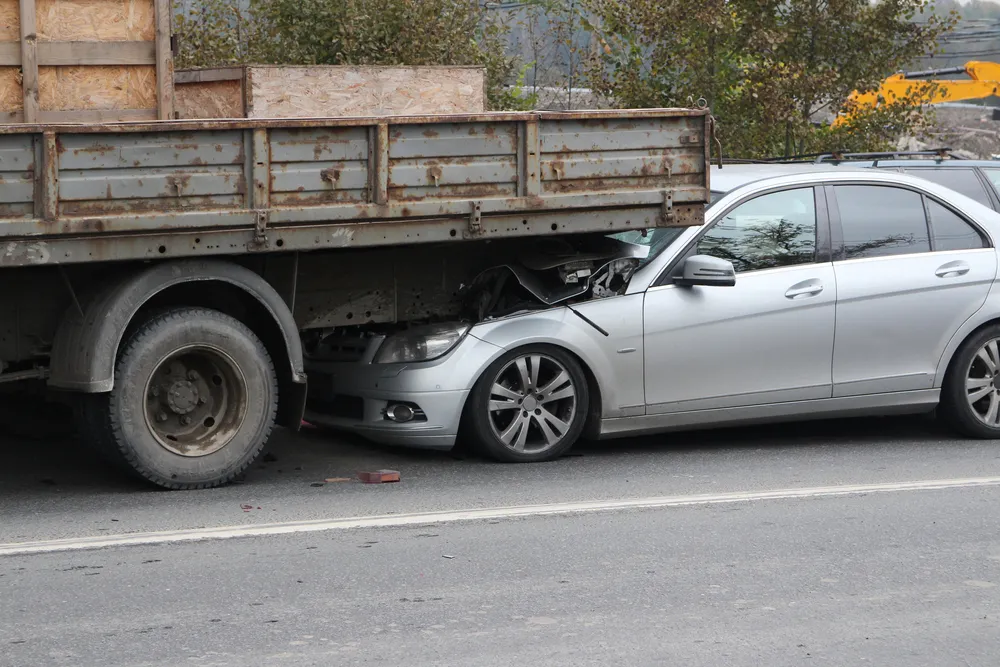
An underride truck accident happens when a car slides under the trailer instead of striking it: from behind, into a stopped or slow-moving rig, or from the side, when a trailer stretches across the road. The front end vanishes under the deck and the impact lands at head height. That's why underride kills so often. When the deck sits 50 inches or higher, NTSB found, the crash reaches the passenger compartment in more than 60% of cases.
Rear underride vs. side underride: key differences and why both are deadly
A rear underride crash happens at highway speed, often at night, when a trailer's outline is hard to see. The law requires a rear guard, but older ones bend and break on impact. Among trailers with the 1998-era guard, NTSB estimated, half the crashes still reached the windshield. Guard failure, even with a guard bolted in place. Side underride is the harder problem legally, since no federal rule requires a side guard at all. And the axles don't save you, whatever the myth says: they're struck in 74% of side impacts, yet 59% of those still end in underride.
Federal underride guard regulations (FMCSA) and common violations
Rear guards fall under 49 CFR § 393.86: every trailer rated at 10,000 pounds or more and built after January 1998 must carry a guard meeting FMVSS 223 and 224 (49 CFR § 571.223 and § 571.224), the underride guard standards for strength and mounting. In 2022, NHTSA tightened those FMCSA underride guard regulations for the first time in decades; the new rules took effect in 2023 and became mandatory in July 2024. Side protection went untouched. NTSB recommended a side-guard mandate back in 2014 (H-14-002), and it still sits open, while the Stop Underrides Act is again stuck in committee. Inspectors find the same violations over and over: a bent guard nobody replaced, mounting set too high, an uncertified aftermarket part. Any one of them builds the case for negligence.
Who can be held liable in a truck underride crash?
A single defendant is rare here. Claims usually run against several parties at once:
- The driver, if he braked hard with no flashers, stopped on an unlit shoulder or pulled across the road
- The trucking company, which under respondeat superior answers for its driver and for skipped maintenance and ignored reports of a damaged guard
- The trailer or guard manufacturer, if the protection was defective or missing altogether
That last defendant is the one people miss. In Hein v. Utility Trailer, a 2019 jury awarded $19 million because the maker left off a side guard federal rules don't even require. Sorting out truck accident liability without a lawyer is hard: every party has its own insurer and its own version of events.
How to prove negligence in a truck underride accident case
A claim rests on four elements: the carrier had a duty to keep the guard sound and drive safely, it breached that duty, the breach caused the crash, and the crash caused harm. The second is where cases are won or lost. Trucks answer to the federal FMCSR rulebook, and a violation is strong evidence the carrier fell short of the industry standard. One caveat in Georgia: a violation alone doesn't make the carrier automatically at fault (it isn't negligence per se), but it persuades a jury better than any argument can.
Critical evidence that wins underride accident claims
Evidence in trucking cases disappears within days, so a lawyer sends the carrier a spoliation letter demanding it be preserved. The case often turns on:
- The ECM, the truck's black box, with speed and braking in the seconds before impact
- Maintenance and inspection logs showing whether a damaged guard was ever repaired
- Dashcam and city traffic-camera footage
- Post-crash measurements of the guard against § 393.86
- The driver's hours-of-service logs, which expose fatigue at the wheel
The carrier holds all of it, and it's the first thing to vanish. Knowing what to do after a truck accident means freezing that data early, before there's nothing left to prove fault with.
Compensation available to underride crash survivors and families
A survivor of underride usually starts in intensive care, in Atlanta most often at the Marcus Trauma Center at Grady Memorial, the only Level I trauma center in the city. Compensation covers medical bills, future treatment, lost earnings, and pain, plus disfigurement when it applies. When the crash is fatal, the family brings the claim. In Georgia a wrongful death truck accident, like any injury suit, carries two years from the crash (O.C.G.A. § 9-3-33), and the right to file belongs to the spouse, or the children if there's none (O.C.G.A. § 51-4-2). One figure the insurer won't advertise: an interstate carrier's minimum coverage is just $750,000 (49 CFR § 387.9). Serious injuries burn through that fast, which is why every defendant matters, the manufacturer included, with its separate product-liability policy.
Why you need a specialized truck accident attorney, not a general PI lawyer
Underride pulls FMCSR, product liability, and several defendants into one case. A general-practice lawyer will miss the regulatory violation the whole claim depends on. While the victim is still in the hospital, the insurer has already sent its people to the scene to build evidence in its favor.
Kermani LLP works trucking cases at that level. We preserve the carrier's data before it's erased, bring in accident-reconstruction experts, and split the fault among driver, company, and manufacturer. As your truck accident lawyer, we work on contingency: no fee until you win. The first consultation is free.


Discover your legal options. Get a free case review, and pay nothing unless we win.



Receive a FREE case assessment
Every case is unique, so we tailor our approach to meet your specific needs.