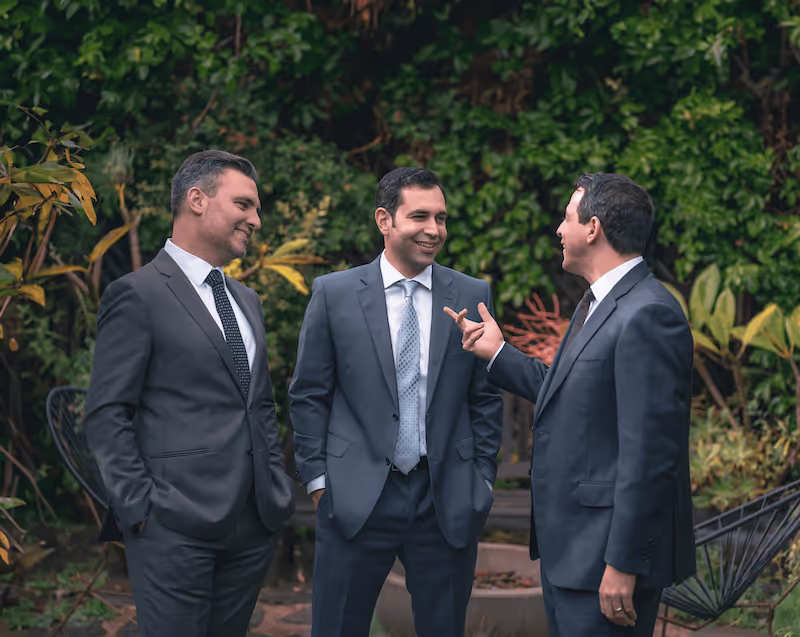


Why us
Why people choose Kermani LLP
Personal Attention & Results: We’re highly-rated by our clients and have recovered over $300,000,000 in combined verdicts and settlements.
Recovered for Clients
Litigated Trials
Successful Cases
Attorneys & Staff
VERDICTS & SETTLEMENTS
We deliver results for our clients
We believe that everyone deserves to be treated fairly, and we're here to fight for our clients' rights.

How it works
About our process
Our approach is thorough and empathetic. We strive to fully understand your situation and all potential damages.
STEP 1
STEP 2
STEP 3
STEP 4
table of contents
Pedestrians don't have protection when a vehicle hits them. No steel frame, no airbags, no seatbelt. A car or truck strikes someone on foot, and the force does devastating damage. Pedestrian crashes in Atlanta have climbed sharply over the past decade. Walking in certain parts of this city is more dangerous than most people realize.
Georgia ranks among the worst states for pedestrians. Survive the collision, and you're still facing injuries that change everything:
- Broken bones
- Traumatic brain injuries
- Spinal cord damage
- Months of recovery that disrupt every part of life
Anyone looking for a hit-by-car lawyer in Georgia needs someone who gets state right-of-way laws and knows the insurance playbook that targets pedestrian claims.
Georgia law may let you seek compensation when a driver's negligence caused the crash. Not simple cases, though. Insurers shift blame onto the pedestrian every chance they get. An experienced Atlanta pedestrian accident lawyer knows how Georgia's right-of-way statutes actually work and can prove driver negligence. Even if you weren't in a crosswalk.
Kermani LLP's Atlanta pedestrian accident lawyers represent injured pedestrians and their families. The pedestrian injury attorneys Atlanta residents trust. Our firm has deep experience litigating cases that involve catastrophic injuries caused by negligent drivers.
Why Atlanta Is Dangerous for Pedestrians
Atlanta's layout puts people on foot at risk in ways most cities don't. Wide multi-lane roads, fast traffic, and sidewalks that appear and vanish without logic. Most neighborhoods were built for cars. You might walk half a mile between safe crossing points just to reach a grocery store or a bus stop.
Sidewalks end mid-block in a lot of areas. You're suddenly walking along the edge of a travel lane. Some intersections have no marked crosswalks. No pedestrian signals. Others force you across six lanes in one signal cycle. Kids, older adults, anyone with mobility issues. These crossings can kill. Even people who follow every signal face real danger because drivers simply don't expect a pedestrian to be there.
The whole system favors cars. Long, straight roads that encourage speeding. Wide turning lanes that let drivers whip through intersections without slowing down. There's almost no margin for error when you're on foot.
Then add the volume. Atlanta keeps growing, and the roads keep filling up with more cars, more delivery trucks, and more rideshare vehicles. Drivers stare at navigation apps instead of the road. Speed, distraction, and bad infrastructure create the same crashes in the same locations over and over.
The High Injury Network
Some Atlanta roads are far deadlier than others. Planners call them the “High Injury Network.” A small slice of corridors produces most of the serious pedestrian crashes. What do they have in common? High speeds, wide lanes, poor lighting, few crosswalks, and heavy traffic.
Buford Highway tops the list. Cars blow through dense residential and commercial stretches at near-highway speeds. Barely any pedestrian infrastructure. People who live and shop along Buford Highway depend on walking or transit. Safe crossing points? Spaced too far apart. So pedestrians cross mid-block. Not because they're careless, but because there's no other option.
Moreland Avenue is a different problem. Truck traffic, cyclists, and residents walking short distances in their own neighborhoods all share the same wide, poorly lit road. Drivers can't see someone on foot at night. If a large vehicle is involved, injuries are often catastrophic.
Peachtree Street in Midtown and Downtown sees crashes tied to turning vehicles. A driver watches oncoming traffic, skips the crosswalk check, and turns left into a pedestrian who has the right of way. Planners call these “left-hook” collisions. They happen constantly at busy intersections.
Piedmont Park is its own hazard. Joggers, dog walkers, festival crowds. Drivers circling for parking, focused on congestion or their phone instead of someone stepping into a crosswalk.
Pedestrians assume drivers see them. Drivers assume the crosswalk is clear. When both are wrong, the consequences can be life-altering.
Pedestrian Fatality Trends in Georgia
The Georgia Governor's Office of Highway Safety tracks the numbers, and they're ugly. Pedestrian fatalities in Georgia have more than doubled since 2013. Recent years: 300 or more pedestrian deaths annually. Georgia ranks near the top nationwide for pedestrian fatalities per capita.
Not just individual mistakes, but systemic infrastructure failure. Roads built without safe crossings, poor lighting, high speeds, and distracted drivers. The danger keeps growing across both urban and suburban areas.
Georgia Pedestrian Laws and Right-of-Way
Georgia's pedestrian laws come up fast after a crash. Most injured pedestrians assume they've got no case. They weren't in a crosswalk. The driver says they “came out of nowhere.” But Georgia law doesn't work that way. Both sides carry responsibilities. Drivers must always use reasonable care to avoid hitting someone on foot.
Fault depends on specifics. Where were you? How fast was the car going? What was the driver doing right before impact?
Pedestrians in Crosswalks (O.C.G.A. § 40-6-91)
Drivers have to stop and yield to pedestrians in a marked or unmarked crosswalk at an intersection. Walk signal, legal entry into the roadway, doesn't matter how you got there. If you're lawfully in that crosswalk, cars stop. Drivers also need to watch for people who move slowly. Children, older adults, anyone with a disability.
Blow past a crosswalk because traffic's moving fast? That's negligence. It can form the basis of a strong pedestrian accident claim.
A crosswalk accident attorney Atlanta pedestrians hire proves liability by showing the driver failed to yield despite clear statutory duties under O.C.G.A. § 40-6-91.
Crossing Outside a Crosswalk (O.C.G.A. § 40-6-92)
Cross outside a crosswalk, and Georgia law says you yield to vehicles. But that's not a free pass for drivers. They can't ignore a person in the road. They can't keep rolling without slowing down.
Drivers still owe due care. They have to take reasonable steps to avoid hitting someone they see (or should see) in the roadway. Speeding, texting while driving, driving impaired, bad lighting, and rain all go into whether the driver acted reasonably. Even outside a crosswalk, drivers must try to avoid the collision when it's reasonably possible.
The “Dart-Out” Defense
Insurers love this one. They argue the pedestrian “darted out” into traffic and the driver had no chance to stop. Sometimes that's true. Rarely. The defense gets used far more often than the facts support. It's a go-to for killing claims or cutting payouts.
But when you actually investigate? Drivers were speeding. Distracted. Not keeping a proper lookout. Traffic conditions, lighting, and sight lines. They often show the driver had time to slow down. They just didn't.
A driver who wasn't paying attention doesn't get to hide behind “dart-out” when the collision could've been avoided.
Can I Sue If I Was Jaywalking
People ask this constantly. They think jaywalking kills their case. Insurance adjusters reinforce that belief. The law doesn't.
Georgia won't bar you from compensation just because you crossed outside a crosswalk. The state runs a modified comparative negligence system. Fault gets split based on what each side did before the crash. Under 50 percent at fault? You recover. Payout shrinks by your fault percentage, but it doesn't vanish. Twenty percent at fault means 20 percent less money. Not zero.
Crashes rarely come down to one thing. You crossed outside a crosswalk, sure. But was the driver speeding? On their phone? Drunk? Not watching the road? That driver may carry most of the blame regardless of where you were walking.
Investigators dig into whether the driver had time to react. Skid marks, vehicle speed, lighting, and sight lines. Video footage and witness statements can show the driver had every opportunity to stop and blew it.
Insurers push jaywalking to deny claims outright. Where you were crossing is one factor. What the driver was doing carries more weight. Speeding, distracted, impaired, not paying attention. Courts also look at whether the driver had enough time and distance to slow down or swerve. A driver's failure to react often outweighs the pedestrian's location.
The Last Clear Chance Doctrine
Georgia also has the “Last Clear Chance” doctrine. Say a pedestrian made a mistake earlier. Crossed where they shouldn't have. But the driver had a final opportunity to avoid the collision and didn't take it. Under this doctrine, the focus shifts to those last moments before impact.
Did the driver see you in the road? Should've seen you? Had time to brake, steer, or do something? They may be legally responsible even if you weren't in a crosswalk. Even if you entered the roadway unexpectedly.
The evidence that matters: vehicle speed, braking distance, lighting, traffic flow, sight lines, dashcam video, traffic camera footage, skid marks, and witness statements. Any of it can show the driver had time to react and didn't. A distracted or speeding driver loses any cover a jaywalking defense might've provided.
This doctrine exists to stop insurers from piling all the blame on the pedestrian. If a driver could've avoided the crash with basic attention, they don't get to walk away clean.
Common Causes of Pedestrian Accidents in Atlanta
Most pedestrian crashes stem from preventable driver behavior. Busy corridors, long crossings, fast traffic, and almost no room for error in Atlanta.
Left-Hand Turns at Intersections
You're crossing with a walk signal. The driver's watching oncoming traffic, not the crosswalk. Turns left. Hits you. This is one of the most common ways pedestrians get hurt in Atlanta. Downtown and Midtown see it constantly. Short signal cycles. Heavy traffic. Drivers feel pressure to complete turns fast. People with the right of way get overlooked.
Planners call these “left-hook” accidents. Drivers claim they never saw you. Not checking a crosswalk before turning is negligence. Even at low speeds, the angle of a left-turn impact does serious damage. No protection on a pedestrian's side.
More of these crashes now involve commercial vehicles. Amazon delivery truck and other delivery van accidents are tied to tight schedules. Drivers rush to stay on route. Take turns too fast. Skip yielding at intersections. A delivery driver causes a pedestrian crash, and liability can extend to the company behind training, supervision, and safety policies.
Distracted Driving in School Zones
School zones and residential neighborhoods across Atlanta see a major share of pedestrian accidents from distracted driving. The driver glances at a phone. Adjusts a nav app. Looks at the dashboard. Misses a child stepping into the road. Kids move unpredictably. One moment of inattention can end in catastrophe.
Drop-off and pickup are the worst times. Drivers rush to work. Blow past reduced speed limits. Don't check the road. Children, parents, and crossing guards are all counting on drivers to pay attention. Distracted drivers miss a pedestrian, and there's no braking before impact. Injuries are severe.
Impaired Driving
Impaired driving remains a serious threat to pedestrians in Atlanta. Alcohol, prescription medications, and illegal drugs all cut a driver's ability to react and make sound decisions. An impaired driver may drift out of a lane. Run a red light. Not notice a pedestrian until impact.
Nights and weekends are the worst because impaired driving spikes during those times.. Crashes happen in poorly lit areas or near entertainment districts with heavy foot traffic. A driver gets behind the wheel impaired, and their actions go beyond simple negligence. That level of recklessness can support a claim for punitive damages.
What If the Driver Fled the Scene
Hit-and-run pedestrian accidents are common in Atlanta. The driver takes off, and you're left thinking there's nothing you can do.
But a lot of people have protection they don't know about. Uninsured Motorist (UM) coverage on your own auto insurance policy often kicks in when an unidentified or uninsured driver hits a pedestrian. You were walking, not driving. Doesn't matter. UM follows the insured person, not the vehicle.
An experienced pedestrian accident lawyer can review your policies. Find applicable coverage. Pursue compensation through UM claims if the driver can't be found.
Catastrophic Injuries We Litigate
Pedestrian injuries tend to be severe because your body absorbs the full force of impact. No crumple zone. No protection.
Common injuries include:
- Traumatic brain injury, including concussions and permanent cognitive damage
- Spinal cord injuries leading to paralysis or chronic pain
- Tibial plateau and tibia/fibula fractures requiring surgery
- Degloving injuries and severe road rash
These injuries often require surgery, rehab, and long-term care. Compensation has to cover both current and future needs. A pedestrian collision results in death? A wrongful death pedestrian lawyer can help surviving family members pursue accountability and financial recovery under Georgia law.
Immediate Steps After Being Hit by a Vehicle
The minutes and hours after a pedestrian accident matter. For your health and for your case.
- Don't move if seriously injured unless you need to get to safety
- Call 911
- Keep your clothing and shoes (evidence)
- Get witness names and video if you can
- Don't talk to insurance companies
Get legal guidance early. It helps preserve evidence and protect your rights before anything gets lost.
Contact Kermani LLP for a Free Case Review
Pedestrian accident cases need detailed knowledge of Georgia law. Insurance coverage. Accident reconstruction. Kermani LLP represents injured pedestrians and families across Atlanta.
Free consultations. No obligation. No upfront cost. A driver's negligence caused serious harm? Reach out to an experienced Atlanta pedestrian accident lawyer and find out where your case stands.

Discover your legal options. Get a free case review, and pay nothing unless we win.
Testimonials
What Our Clients Say About Us
We are committed to providing our clients with the best possible service, and their feedback is what drives us to be better.
Frequently Asked Questions
Our personal injury team is here to help. Get a free case evaluation.
Do pedestrians always have the right of way in Georgia?
No. Cross outside a crosswalk, and you're supposed to yield. But drivers still owe due care. They have to try to avoid hitting pedestrians they can see or should see in the roadway.
Can I recover compensation if I was jaywalking?
Yes. Georgia's comparative negligence system lets you recover as long as you were under 50 percent at fault. Your compensation gets reduced by your fault percentage. Doesn't get eliminated.
Who pays my bills if the driver fled?
Your own auto insurance, potentially. Uninsured Motorist (UM) coverage often applies to pedestrians. You weren't in a vehicle? Doesn't matter. UM follows the policyholder. A lawyer can review your policy and confirm what's available.
What is the statute of limitations for pedestrian accidents?
Two years from the date of the accident under O.C.G.A. § 9-3-33. But government entities like MARTA or the City of Atlanta? You may need to file formal notice within six months. Don't sit on this.
How much is my pedestrian accident case worth?
No two cases look the same. Pedestrian crashes produce worse injuries than typical car-on-car collisions. They often invovle higher medical costs, longer recovery and a greater impact on your ability to earn. The number depends on how severe your injuries are, what insurance is available, and how strong the liability evidence is.
Practice areas
Explore More
Explore other practice areas our firm specializes in
Receive a FREE case assessment
Every case is unique, so we tailor our approach to meet your specific needs.