Jackknife Truck Accidents in Atlanta: Who is Liable For Your Injuries?
table of contents
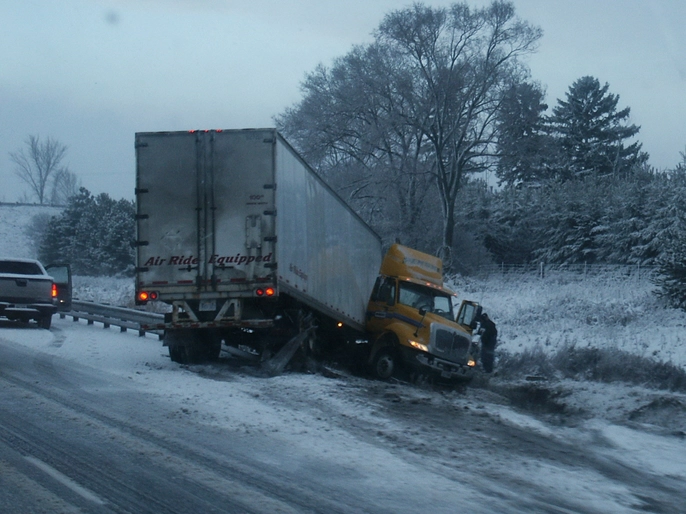
You're on I-285 and an 80,000-pound tractor-trailer folds in half two cars ahead of you. The trailer swings 90 degrees across three lanes. There is nowhere to go.
That's a jackknife truck collision. It happens at Spaghetti Junction, at the I-285/I-20 interchange, along the industrial corridor between Exits 30 and 40. About 240,000 vehicles travel I-285 every day (per GDOT traffic counts), and a big chunk of those are tractor-trailers from distribution hubs along the Perimeter.
After a wreck like that, the first question everyone asks is who pays? Honestly, the answer almost never comes down to one person. The driver, the trucking company, the cargo loaders and the parts manufacturer can all share fault. Below we break down who is liable in a jackknife accident under Georgia law, what evidence to preserve, and what compensation you can go after.
Who Can Be Held Liable in an Atlanta Jackknife Crash?
In a commercial motor vehicle (CMV) crash this big, you can file claims against multiple defendants under both federal and Georgia law. Each one carries separate liability for its part in what happened.
The Truck Driver's Negligence
The FMCSA Large Truck Crash Causation Study found that driver actions were the critical factor in 87% of serious truck crashes. Only 10% came down to vehicle defects and 3% to weather or road conditions. So the driver is almost always part of the problem.
What does that look like? A driver takes a curve too fast on an interchange and slams the brakes in heavy traffic. The trailer keeps moving forward and causes semi-truck jackknifing. Or someone gets behind the wheel after 11 straight hours of driving, even though federal Hours of Service rules (49 C.F.R. Part 395) say you can't do that. And others just falsify their electronic logs to cover it up.
Every one of those is negligence per se under Georgia law. You prove the violation and you've proven fault. We've written separately about other common causes of truck accidents in Atlanta.
The Trucking Company and Vicarious Liability
The Georgia Supreme Court confirmed in Piedmont Hospital v. Palladino (276 Ga. 612) that under respondeat superior, a carrier is on the hook for what its drivers do on the job. But it usually goes further than that. Maybe the company hired a driver with a bad record, or leaned on its people to push past Hours of Service limits, or just skimped on maintenance. FMCSA says carriers can't hand off these responsibilities to subcontractors, so the whole “independent contractor” defense falls apart. We've seen companies try it. Doesn't work.
Third-Party Cargo Loading Companies
When cargo weight shifts mid-turn, the trailer loses stability, and that's one of the main ways a jackknife starts. The load doesn't have to be overweight, just poorly distributed. Federal standards (49 C.F.R. §§ 393.100-393.136) set requirements for tie-downs, blocking, and weight distribution, with a max gross weight of 80,000 pounds. If the loading company cut corners on any of that, it shares liability alongside the driver.
Truck Manufacturers and Maintenance Providers
Sometimes the truck itself is the problem. Brakes that give out on a wet road, tires that should have been replaced months ago, an ABS that malfunctions and a coupling between cab and trailer that's come loose. The manufacturer answers for that under products liability, and the service company that signed off on a bad inspection answers for negligent maintenance. Federal rules (49 C.F.R. Part 396) say carriers have to keep inspection records for at least 14 months, which gives your attorney something to work with.
How Georgia's Modified Comparative Negligence Affects Your Claim
Georgia has what's called a 50% bar rule (O.C.G.A. § 51-12-33). If a jury decides you were 50% or more at fault, you get nothing. Below that, your award shrinks by your percentage of blame. So 30% fault means you lose 30% of the payout.
Trucking company insurers know this. They're good at it, to be fair. Their whole approach is to build a case around your speed, your following distance and the exact moment you hit the brakes. Every percentage point they pin on you saves them money. Even when you did nothing wrong, they'll keep digging.
Evidence Needed to Prove Fault in a Commercial Truck Accident
Time is short. Anyone who's handled a truck case will tell you the same thing. Trucking companies dispatch response teams to the crash site within hours. Black box (EDR) data can be overwritten in days. Driver logs, dashcam footage, and maintenance records disappear within weeks.
You'll need the EDR/ECM data showing speed and braking force right before impact. The ELD records that log actual hours behind the wheel matter just as much, because Hours of Service violations are one of the easiest things to prove. Your attorney will also want drug and alcohol test results (the BAC limit for commercial drivers is 0.04%, half of what it is for everyone else), maintenance documents going back 14 months, and any road camera footage, dashcam recordings, or witness statements you can get your hands on.
This is why an attorney's first move is always a spoliation letter. It legally compels the company to preserve all records. Without that letter, the company has no obligation to keep a single document, and they know it.
Compensation You Can Recover After an Atlanta Truck Crash
The injuries from these crashes are life-changing. We're talking traumatic brain damage, spinal cord injuries including paralysis, fractures in multiple places and internal bleeding that doesn't show up until you're at the ER. Rehab at Shepherd Center or treatment at Grady Memorial runs into hundreds of thousands of dollars. And that's just the medical side. Between medical bills and lost wages, people's finances get destroyed.
You can go after medical expenses (including future treatment and long-term rehab), lost income, reduced earning capacity, pain and suffering, and loss of quality of life. If the driver was drunk or the company knew about bad brakes and did nothing, the court can add punitive damages under O.C.G.A. § 51-12-5.1 on top of everything else.
Why You Need an Experienced Atlanta Truck Accident Attorney
These aren't normal car accident cases. You're up against federal FMCSA regulations layered on top of Georgia law, multiple defendants with their own insurance and their own lawyers, and corporate legal teams that get to work within hours of the crash. The statute of limitations gives you two years (O.C.G.A. § 9-3-33) but evidence starts vanishing long before that.
Kermani LLP takes on major trucking companies across Georgia. More than $100 million recovered for clients. Contingency fee, meaning you pay nothing until we win.
Hurt in a jackknife accident on I-285, Spaghetti Junction, I-20, I-75, or anywhere else in Atlanta? Call an Atlanta truck accident attorney at Kermani LLP. Free consultation. Available 24/7.


Discover your legal options. Get a free case review, and pay nothing unless we win.



Receive a FREE case assessment
Every case is unique, so we tailor our approach to meet your specific needs.