Hit by a car while jaywalking in California: Can you still get compensation?
table of contents
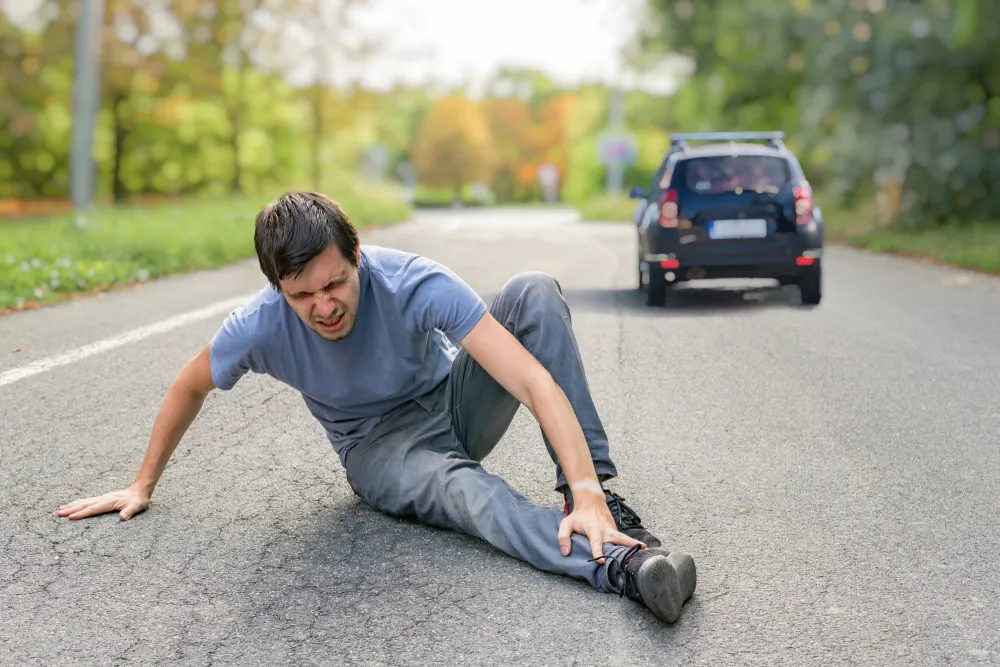
When a car hits a pedestrian outside a crosswalk, the insurer almost always says the same thing: it's your fault, you crossed the wrong way. Many injured people take that at face value. Jaywalking, they figure, means no payout.
In California, that's far from true. Since 2023, the state has stopped treating most mid-block crossings as a reason to ticket anyone, and fault gets split more gently than people assume. Partial fault on the pedestrian's side almost never wipes out their recovery. Here's how jaywalking in California really affects your personal injury claim and why the adjuster's 100% fault story doesn't deserve the benefit of the doubt.
Understanding the new jaywalking California law
On January 1, 2023, the Freedom to Walk Act (AB 2147) took effect. This jaywalking California law didn't change whether you can cross outside a crosswalk. It changed whether police can punish you for it. Now an officer can ticket a pedestrian in just one case: when a reasonably careful person would see an immediate danger of a collision.
The law didn't make crossing outside the lines fully legal. It only narrowed when police can cite you. The jaywalking fine in California hasn't gone anywhere: the base $196 to $250 before court fees still stands. An officer can realistically write it only where the crossing was genuinely dangerous.
Is it illegal to jaywalk in California today?
Short answer: most of the time, there's nothing to punish. So is it illegal to jaywalk in California by the strict letter of the code? Crossing in the wrong spot is still technically a violation, but after AB 2147, police can't stop you unless there was an immediate danger of a collision.
Insurers also stay quiet about one detail. Under the California Vehicle Code, not every crossing outside the lines even counts as a violation. Beyond the marked crosswalk with painted lines, CVC 275 recognizes the unmarked crosswalk: at an ordinary intersection where sidewalks meet at right angles, a legal crosswalk exists without any paint. Someone on that invisible line is already in a crosswalk, and the driver must yield under CVC 21950. The ban in CVC 21955 is narrower than most think: it covers crossing between two adjacent intersections when both have signals.
If you hit a jaywalker who is at fault California?
If you hit a jaywalker, who is at fault in California? That question rarely has a black-and-white answer. Even when a pedestrian crosses in a bad spot, the driver almost never walks away clean, because the law puts duties on both sides.
CVC 21954 says it plainly: a pedestrian outside a crosswalk must yield the right-of-way to cars close enough to be an immediate hazard. But the right-of-way isn't absolute. The same section adds that a pedestrian's mistake doesn't relieve the driver of due care, and CVC 21950 tells drivers to slow down. If the driver was scrolling a phone or moving faster than traffic, the blame shifts their way. A speeding driver or distracted driving moves the needle far more than the word jaywalking.
The statistics cut against easy answers. In recent years, roughly 1,106 pedestrians are killed on California roads each year, more than in any other state. Pedestrian error is the primary factor in nearly half of serious crashes, yet the researchers add a caveat: the primary factor doesn't decide who is legally at fault. A pedestrian jaywalked and a pedestrian being 100% to blame are two very different claims. Almost always, the real story is shared fault.
How pure comparative negligence affects your compensation
This is where California stands apart from many states. It runs on pure comparative negligence: your compensation drops by exactly the percentage of fault assigned to you, but it never falls to zero. Even at 99% fault, the law still leaves you the remaining 1% of your damages.
That was a deliberate choice. In Li v. Yellow Cab Co. (1975), the California Supreme Court threw out the old all-or-nothing rule and rejected the 50% model, where a plaintiff who is 51% at fault recovers nothing. Today the jury instruction CACI 405 keeps that logic in place.
Here's the math. Say a jury puts your total damages (medical bills, lost wages, pain and suffering) at $200,000 and your share of fault at 30%. Your personal injury settlement then comes to $140,000. Even at 90% fault, you'd walk away with $20,000 rather than nothing. Real numbers depend on your injuries, and what the average pedestrian hit by a car in California recovers is worth a look.
Why you need a California pedestrian accident lawyer
This is exactly why insurers cling to the word jaywalking. Pinning all the fault on the pedestrian is the cheapest way to close a file. An insurance claims adjuster may call the day after the crash, ask for a recorded statement, and turn your words against you. Tell them you never saw the car, and suddenly you're to blame. That's just one of the tactics adjusters use to shortchange injured people.
A lawyer breaks that script with evidence. In the spirit of the Kermani Method, the investigation starts with proof an insurer would rather not see: footage from nearby buildings and signals, black box data on speed and braking, the driver's phone records and accident reconstruction reports. Together they show the driver was going too fast or looking away, and that fault was shared all along. None of this is quick, and how long a California injury case takes depends on how hard the insurer fights.
Kermani LLP has recovered more than $100 million for clients and charges no fee until you win. If a car hit you on a California road, talk to a California pedestrian accident lawyer before you give the insurer a statement and report the crash to the DMV on time. The first consultation is free, and the word jaywalking almost certainly means less than they want you to believe.


Discover your legal options. Get a free case review, and pay nothing unless we win.

Receive a FREE case assessment
Every case is unique, so we tailor our approach to meet your specific needs.