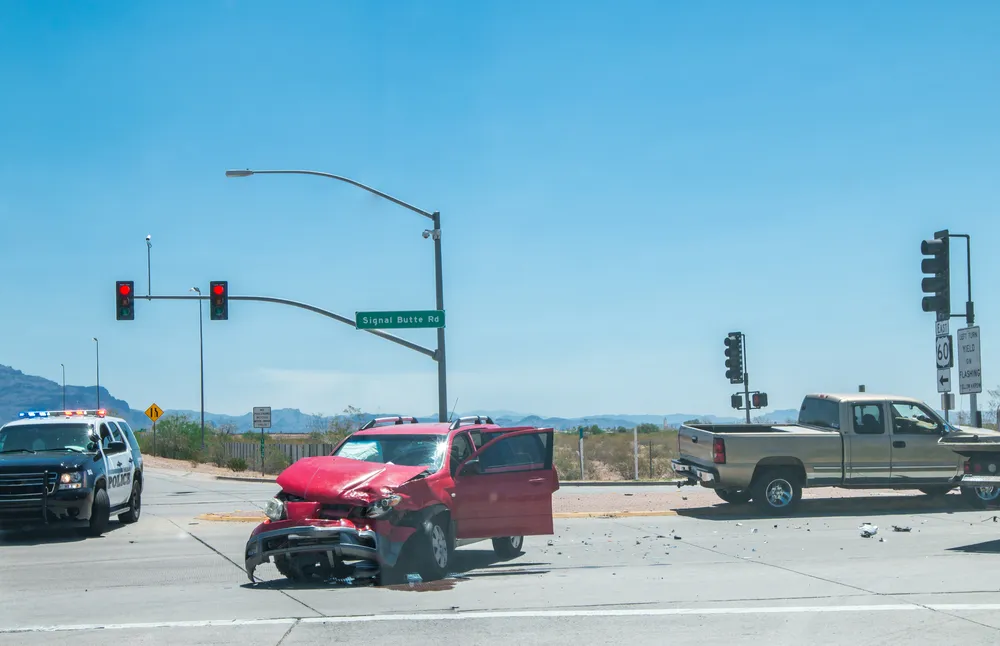
Who Pays for a Multi-Car Pileup on the I-10 in Phoenix?
table of contents
The I-10 is the deadliest highway in Arizona. Where it crosses open desert between Phoenix and Tucson, summer haboobs roll in without warning and cut visibility to zero in seconds. Near Picacho Peak in October 2013, 19 vehicles piled into each other: three people died and more than a dozen were hurt. In March 2025, another dust-storm pileup near Tonopah killed four more and left cars burning on the freeway.
When ten or twenty cars fold into one wreck, the question of whose insurance pays in a multi-car accident rarely has a clean answer. Fault usually lands on more than one driver, and just as many insurers get pulled in. How they split the blame decides what you walk away with. Here is how Arizona sorts out who is at fault and who pays.
How fault is determined in an Arizona multi-vehicle pileup
The police report is a starting point, not a verdict, and it rarely shows who set the chain in motion. Most cars carry an event data recorder, the black box, which logs speed, braking, airbag deployment, and delta-V, the sharpness of the impact. Line up the timing across several vehicles, and a reconstructionist can rebuild who hit whom, in order. ADOT cameras, other drivers' dashcams, skid marks, and damage patterns fill in the rest. Holding onto that evidence starts at the scene, which is where our guide on what to do after a car accident in Arizona comes in.
A common assumption is that whoever hit first caused it all. Arizona does not see it that way. Each driver is judged on their own conduct. Someone who followed too closely and could not stop in time violates A.R.S. § 28-730 and carries a share of the fault, no matter how the crash began. In a dust storm that matters even more: witnesses often saw nothing, so the instrument data decides the case.
Arizona's comparative fault rules and what they mean for injury victims
Arizona is a pure comparative fault state (Arizona Revised Statutes, A.R.S. § 12-2505). Even a partially at-fault victim still recovers, just reduced by their share. Say a jury values your losses at $100,000 and finds you 20% to blame. You collect $80,000. There is no 50% cutoff here like in other states. The one exception: anyone who caused the harm intentionally, willfully, or wantonly cannot claim comparative fault at all.
Insurers know this rule as well as any lawyer, and from day one they pin extra points on you. Every 10 points of blame they shift is a tenth of your payout gone.
Which insurance company do you file with after a chain-reaction crash?
Recovery usually comes from more than one source at once, and who gets blamed decides whose insurance pays in a multi car accident. Three options are typically in play:
- The at-fault driver's liability policy, or each driver's policy if several share the blame.
- Your own uninsured/underinsured motorist coverage, UM/UIM. It kicks in when the at-fault driver has no insurance or not enough. A.R.S. § 20-259.01 governs it, and about one in ten Arizona drivers carries none at all (10.6% in 2023).
- Your own collision coverage when you need money fast.
With a dozen cars come a dozen insurers, each insisting the bill belongs to someone else. A multi-vehicle claim almost always turns into a fight among the insurers themselves.
What if the at-fault driver's insurance doesn't fully cover your damages?
Arizona's minimum policy covers $25,000 per injured person and $50,000 per accident (A.R.S. § 28-4009, after the state raised the limits in July 2020). For a two-car fender bender, that sometimes works. In a pileup, almost never. Five badly hurt people split that same $50,000, about $10,000 each, nowhere near the average $65,760 hospital charge after a Phoenix crash.
So you look elsewhere. Claims go to every driver who shares the fault. Your own UM/UIM comes in too, and in Arizona you can stack the limits across multiple cars on one policy unless the contract clearly forbids it, which the state Supreme Court confirmed in Franklin v. CSAA. Then there is the deeper pocket: a commercial truck or work vehicle in the chain puts an employer with a much larger policy on the hook. At Picacho Peak, ten of the 19 vehicles were trucks.
Types of compensation available to multi-car accident victims
Damages fall into two buckets. Economic losses come off the receipts: medical care, future treatment, lost income and vehicle repair. Non-economic losses are the ones no receipt captures, the pain, the emotional toll, the life you no longer get to live. When someone dies, the family gets a separate wrongful death claim. A spouse, child, parent, or personal representative can bring it (A.R.S. § 12-612); the jury sets the amount by a "fair and just" standard, and those funds are shielded from the deceased's debts (A.R.S. § 12-613). The deadline is two years from the date of death, not the crash (A.R.S. § 12-542).
Why multi-car accident cases are complicated, and why victims need a lawyer
The hard part is not the law. It is that everyone else in the wreck works against you: insurers pin the blame on each other and on you, so each pays less. Evidence disappears fast, too. Black boxes overwrite within days and camera footage has a short shelf life, so a lawyer sends preservation letters within 24 hours. And every point of fault stays open to dispute, because each one comes straight out of your recovery.
This is not a case for a general-practice attorney. The Phoenix car accident lawyers at Kermani LLP handle these across Arizona: we track down every defendant, surface every policy, and refuse to let insurers lowball the number. We work on contingency, so there is no fee unless you get paid. To see how to push a claim to its full value, read our guide on how to maximize your accident settlement in Arizona. Start with a free case review: contact Kermani LLP today.


Discover your legal options. Get a free case review, and pay nothing unless we win.



Receive a FREE case assessment
Every case is unique, so we tailor our approach to meet your specific needs.